
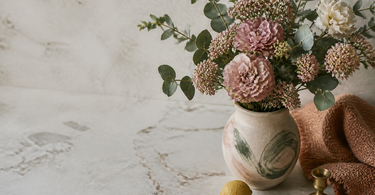
Artificial flowers in 2024 aren't what they were 20 years ago. Modern versions have wire in the stems, graduated colours and lifelike vein detailing on the leaves — and they last for years without water or care. It's all about choosing flower types that are easy to fake convincingly (eucalyptus, peonies, olive branches), placing them in a good vase and bending the stems so they look natural.
There was a time when artificial flowers were synonymous with faded plastic roses on a serving tray at your gran's. Those days are over. Today's artificial flowers are made with a level of detail that makes them hard to spot even up close: stems with real wire inside, petals in multiple layers and shades, leaves with visible veining and a matt surface that resembles the real thing. The result is flowers you can enjoy all year round — without a single watering can.
Why choose artificial flowers?
The case for artificial flowers isn't about fooling anyone. It's about practicality and economy. A bunch of fresh flowers typically costs 100–200 DKK and lasts a week. Good-quality artificial flowers cost more upfront, but pay for themselves within a month or two — and last for years after that.
- No maintenance. They don't need watering, trimming or fresh water. Set them down and forget about them.
- Allergy-friendly. If you have hay fever or a pollen allergy, you can finally have flowers in your home without the side effects.
- Season-independent. Fancy peonies in December or cherry blossom in October? With artificial flowers, it's entirely possible.
- Material flexibility. Because there's no water involved, you can use vases made from materials that normally wouldn't cope with moisture — unglazed ceramic, metal, wood.
- Stable styling. Fresh flowers change in appearance day by day. Artificial flowers keep the look you've set them to.
Quality differences: cheap vs. realistic
Not all artificial flowers are created equal, and the price difference is directly reflected in how convincing they are. Cheap versions from budget shops are easy to spot: a plasticky surface, uniform colours from stem to petal, stiff stems that don't move naturally. The pricier, more realistic artificial flowers have four traits you should look out for:
Stems and wire
Good artificial flowers have wire inside the stems. This lets you bend and shape them so they fall naturally — just like real flowers do in a vase. A stiff, upright plastic stem is the quickest sign of low quality.
Petals with variation
Real flowers are never a single flat colour. The best artificial flowers have a gradient — lighter towards the centre, darker towards the edge — and small "imperfections" like brownish edges or slightly curled petals. Uniform, mirror-glossy petals give themselves away instantly.
Leaves with texture
Realistic leaves have visible veins and a matt surface. Glossy, flat leaves without vein detailing are a sure sign that corners were cut in production.
Weight and materials
Quality artificial flowers feel heavier than cheap versions, because they use denser materials — often a combination of fabric, silk and polymer rather than pure plastic. Weight isn't a guarantee of quality, but it is an indicator.
Tip: Buy fewer flowers of better quality rather than lots of cheap ones. Three well-made eucalyptus branches in a good vase will always beat an overstuffed bunch of see-through plastic roses. Feel free to mix in dried flowers too — it adds extra texture and makes the whole arrangement more convincing.
Which flower types look the most lifelike?
Not all flowers can be copied equally convincingly. Some flower types are structurally easier to imitate than others.
Eucalyptus
Eucalyptus is nearly impossible to spot as artificial — partly because real leaves already have a slightly plasticky surface, partly because the colour (blue-green with grey tones) is easy to reproduce convincingly. A single branch in a tall vase is a classic that never looks cheap.
Peonies
The peony's many layers of petals do a great job of hiding that the flower is artificial. The complex structures are actually easier to fake convincingly than simple flowers like tulips, because the details blend into one another.
Olive branches
Olive branches with small fruits look very true-to-life and suit many styles of decor, from Scandinavian to Mediterranean aesthetics. They're robust in expression and easy to place individually.
Avoid these — unless the quality is high
Sunflowers and tulips are harder to make realistic, because the real flowers have very distinctive texture and colour gradation. Cheap artificial versions of these two are instantly obvious. If you're a fan of tulips, spend the money on a good version.
Styling with artificial flowers
The biggest mistake is treating artificial flowers exactly like fresh ones — cramming them into a vase and hoping for the best. Here are four approaches that work better:
- One branch, one vase. A single eucalyptus branch in a large floor vase can be all a room needs. Simplicity always beats an overcrowded bouquet.
- Mix with dried flowers. Artificial and dried flowers complement each other well and give a more organic texture overall. Dried pampas grass or reed canary grass combines naturally with artificial peonies.
- Group by type, not mixed. Instead of a mixed bouquet of everything, you can gather three to four identical flowers in one vase and another element in another. It gives a more streamlined result.
- Actively bend the stems. Use the wire to create natural curves. Let some stems fall to the side, others stand more upright. Asymmetry is your friend.
If you want to go all-in on the green look indoors, you can combine artificial flowers with real plants in pot covers — that way, you only need to water what actually needs water.
The right vase for artificial flowers
The absence of water opens up possibilities you don't have with fresh flowers. You can use vases in materials that normally aren't suited to moisture: unglazed ceramic, ceramic with cracks and crackle effects, metal, wood or woven material.
Character vases as a statement
Animal vases from Quail work brilliantly for a single artificial flower sticking up from the ceramic bird's or animal's back — it's an arrangement that doesn't need more than one element to have personality. See Quail's vase collection for inspiration for characterful single arrangements.
Colour against colour
Colourful vases can either match the flower colour for a monochrome look or contrast for a more playful feel. Try a deep terracotta vase with blue eucalyptus, or an ochre vase with pink peonies.
Spread out rather than gather
Do you have lots of artificial flowers? Spread them out in small vases around the home instead of gathering them in one place. This creates a more natural feel and avoids what's best described as the "museum-for-artificial-flowers" look.
| Vase type | Suited for | Effect |
|---|---|---|
| Large floor vase | Long branches, eucalyptus | Architectural, fills the room |
| Small ceramic vase | Single flower, short stems | Intimate, decorative detail |
| Animal vase | Single flower as an accent | Humorous, characterful |
| Coloured vase | Monochrome bouquet or contrast | Eye-catching play of colour |
| Unglazed ceramic | Organic branches, dried elements | Earthy, textured |
Maintenance and lifespan
Artificial flowers aren't entirely maintenance-free — they just require very little. Follow three simple rules and they'll last for years.
- Dust regularly. Use a soft brush or a hairdryer on cold air to remove dust from leaves and petals. A layer of dust is the main reason artificial flowers start to look worn.
- Deep cleaning a couple of times a year.Dip the flowers in lukewarm water with a little washing-up liquid, rinse them thoroughly and leave them to air-dry lying flat. Avoid pressing on the petals while they're wet.
- Avoid direct sunlight.Even the best artificial flowers fade over time in direct sunlight. South-facing windowsills are the most aggressive spots — move the flowers away from there, or accept that they'll need replacing more often.
A simple trick to avoid the "static" look: move the flowers around your home every so often. A eucalyptus branch that's sat on the same shelf for two years starts to become invisible. Put it in a new room and it feels fresh again.
Frequently asked questions
Can artificial flowers stand outdoors?
Most artificial flowers are intended for indoor use. UV radiation and weather conditions — rain, temperature swings — break down the materials considerably faster than indoors. If you want artificial flowers on the terrace or in an outdoor entrance, look specifically for varieties labelled UV-treated or UV-resistant.
How do I stop artificial flowers looking cheap?
Three things make the biggest difference: choose flower types that are naturally easy to fake convincingly (eucalyptus, peonies, olive branches). Actively bend the stems so they fall naturally. And place them in a vase with character — a good vessel lifts the flower, whatever the price.
Is it possible to mix artificial and fresh flowers?
Yes, and it can actually make both better. Artificial branches like eucalyptus or olive leaves add structure and volume to a bouquet of fresh flowers — and they survive the water with no trouble. Conversely, fresh flowers can lend an artificial bouquet credibility through scent and movement.
Which flowers are hardest to make look true-to-life as artificial ones?
Tulips and sunflowers are generally difficult, because the real flowers have very distinctive surface texture and a colour gradient that's complex to reproduce. Cheap versions of these two flowers are instantly obvious. Wild anemones and orchids are similarly hard to make convincing.
Can artificial flowers be used in a vase without water?
Yes — it's actually an advantage. Without water, you can use vases in any material, including unglazed ceramic, metal and wood, which normally aren't suited to fresh flowers. You can also use vases with an opening too narrow for fresh stems, because artificial stems are thinner and more flexible.
How long a lifespan can you expect from good artificial flowers?
Good-quality artificial flowers, kept away from direct sunlight and dusted regularly, can last 5–10 years without noticeable deterioration. The main cause of deterioration is UV light, which slowly fades the colours. Dust that settles and isn't removed is the second biggest factor.
Summary
Artificial flowers have undergone a real quality upgrade in recent years. With wire in the stems, graduated colours and true-to-life leaf texture, the best varieties are hard to tell apart from fresh flowers — and they last for years without any care. The key is to choose flower types that are structurally easy to reproduce well (eucalyptus and peonies are the safest bets), actively bend the stems, and place them in a vase with personality. Feel free to combine them with dried flowers for extra texture, and spread them small vases around your home rather than gathering everything in one place. Avoid direct sun, dust them off every so often — and that's it.
Explore our range of vases for artificial flowers — from characterful animal vases to colourful ceramic vases in every size.
