
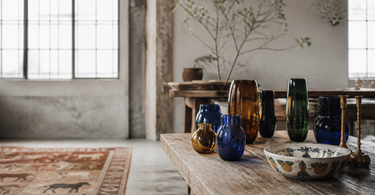
Anna Von Lipa makes mouth-blown glass in crystal, opal and coloured glass — everything from crystal candlesticks to thin-walled wine glasses. Each piece is shaped by hand, so small variations in shape and thickness are a hallmark, not a flaw. The glass is recommended to be hand-washed in lukewarm water with mild soap. The range can be freely mixed across colours and sizes.
Mouth-blown glass has a distinctive quality that machine-produced glass never quite replicates: the wall isn't perfectly uniform, the base isn't identical to its neighbour's, and the light behaves a little differently in each individual piece. That's exactly where Anna Von Lipa lives. The brand has built its expression on the craftsmanship that arises when a glassblower shapes hot glass with lungs and hands — and the result is glass that carries its own mark from day one.
What is Anna Von Lipa?
Anna Von Lipa is a Danish brand specialising in mouth-blown glass for the table and home. The range covers drinking glasses, candlesticks, jugs and vases — and what they all have in common is that they're shaped by craftspeople with many years of experience in traditional glassblowing techniques.
The brand has earned a solid position in Danish home decor. The glass regularly appears with stylists and in magazines, not because it's trendy for a season, but because it has a timelessness that makes it easy to integrate into many different interior styles — from the minimalist to the more decorative.
What sets mouth-blown glass apart from machine-produced glass?
In machine production, a fixed amount of molten glass is injected into a precise mould and cooled under controlled conditions. The result is identical pieces with uniform wall thicknesses. In mouth-blowing, the glassblower blows air into a glowing mass of glass and shapes it with rotation and movement. The process requires decades of experience and is never 100% reproducible. The wall thickness varies by a few tenths of a millimetre, the shape isn't mathematically perfect — and that's exactly what gives each piece its individual character.
At Anna Von Lipa, these variations aren't something one tries to minimise. They're part of the product's identity.
The three glass types
Anna Von Lipa works primarily with three glass types, and they have very different properties:
| Glass type | Properties | Typical products |
|---|---|---|
| Crystal glass | Clear, heavy, high light refraction. Rings when lightly tapped. | Candlesticks, finer drinking glasses |
| Opal glass | Semi-transparent, soft milky surface. Organic, warm feel. | Jugs, vases |
| Coloured glass | The colour is part of the glass mass — not painted on. Lasts forever. | Drinking glasses, vases, candlesticks |
Crystal differs from ordinary glass in its lead oxide or zinc oxide content (in modern lead-free versions), which increases the refractive index and gives it its characteristic shine and ring. Opal glass achieves its rich, white tone by adding fluorides or phosphates during production, which makes the glass mass opaque.
Tip: If you want to mix glass types on the table, crystal and coloured glass work particularly well together — the clarity of the crystal gives space for the coloured pieces' expression without competing. Opal glass works best as a standalone element, for example a single jug in the middle of the table.
Crystal candlesticks
Anna Von Lipa's crystal candlesticks have become a recognisable feature of Danish home décor. They come in a wide range of shapes: slender, simple models that don't draw attention, and more sculptural designs with facet cuts that break the light and cast small prisms around the room when a candle is lit.
A facet cut isn't just decorative. It works by having each flat surface in the cut angle the incoming light in a specific direction, just like a prism. The deeper and sharper the cut, the more dramatic the light effect. That's why the same crystal candlestick looks very different in daylight compared with candlelight.
The candlesticks are well suited to being gathered in groups. Many choose to combine different heights from the same series — for example 8, 12 and 18 cm models — to create an organic composition on the dining table or in the windowsill. See the full range of crystal candlesticks for an overview of the available sizes and shapes.
Because crystal is heavier and more fragile than ordinary glass, the candlesticks should be stored so they don't touch each other directly. Crystal can scratch crystal, even with light contact.
Wine glasses and champagne glasses
Drinking glasses are an area where craftsmanship really makes a noticeable difference. A mouth-blown wine glass typically has a thinner and more evenly rounded rim than a machine-made glass. The rim is crucial to the drinking experience: it guides the liquid towards the tongue and lips in a way that feels more natural.
Anna Von Lipa's wine glasses are characterised by a light stem, good balance and a relatively thin-walled bowl. This gives the glass a lightness in the hand that you'd normally associate with more expensive artisan glassware. The stem isn't excessively thin — it's designed for everyday use, not just festive occasions.
Flute or coupe?
For champagne and sparkling wines, Anna Von Lipa offers both classic shapes. The flute — the slender, tall glass — retains the bubbles longer, because the surface from which CO₂ is released is relatively small. The coupe glass, with its wide, flat bowl, releases bubbles quickly and is therefore not ideal if you want to keep the bubbles for a long time. On the other hand, it's well suited to cocktails, spritzes and festive drinks, where the bubbles aren't the main point. Explore champagne glasses in both variants and choose based on what you'll mainly use them for.
Both types can be combined on the same table to good effect — use the flute for the champagne and the coupe glass for the cocktail before dinner.
Jugs in opal glass
Opal glass is one of those materials that takes a bit of getting used to, because it behaves differently to clear glass. Its semi-translucent, almost milky look gives jugs a soft and almost sculptural feel — they look different depending on the angle you view them from and whether there's strong light behind them.
Anna Von Lipa's jugs in opal glass are practical in the sense that they can be used for water, juice, lemonade or as a vase for loose flower branches. The material is neutral enough that it doesn't dominate the table setting — but it adds a texture and depth that clear glass doesn't have.
For larger gatherings, where the table has many elements, a single jug in opal glass works well as a calm centrepiece. For a more minimal setting, it can stand alone and carry the whole visual expression.
Care and maintenance
Mouth-blown glass and crystal are more vulnerable than industrially produced glass, and they require a little extra attention to preserve their shine and clarity over time.
Dishwasher: a clear no
High temperatures and aggressive enzymes in dishwashing detergents gradually break down the glass's surface. This results in a dull, white coating that cannot be removed. Anna Von Lipa consistently advises against dishwashers for all their products. Handwashing is the only recommended method.
Correct washing technique
- Use lukewarm water — avoid sudden temperature changes, which can stress-fracture the glass.
- A mild, non-enzymatic washing-up liquid is sufficient.
- Dry immediately with a soft, lint-free cloth — don't let the glass air-dry, as this leaves limescale marks.
- Store crystal glasses and candlesticks so the pieces don't touch each other directly.
A polished crystal glass, stored correctly, keeps its shine for decades. That's one of the reasons why mouth-blown quality glass is actually a better long-term investment than cheap dishwasher-safe alternatives.
Frequently asked questions
Where are Anna Von Lipa glasses produced?
Anna Von Lipa glasses are mouth-blown by experienced glassmakers in collaboration with established European glass workshops that have mastered the traditional mouth-blowing technique. Production doesn't take place industrially, but in smaller craft-based facilities, where the glassmakers work with the same basic tools as a hundred years ago: a long blowpipe and molten glass.
Is Anna Von Lipa glass dishwasher safe?
No — and that goes for crystal, opal glass and coloured mouth-blown glass alike. High temperatures and strong detergents break down the surface and can make the glass dull and cloudy over time. Hand washing in lukewarm water with mild soap is the recommended method. Dry immediately with a lint-free cloth.
Can you mix different Anna Von Lipa series on the table?
Yes, that's actually part of the concept. The differences in shape, colour and size are harmonious enough that most combinations work visually. Many people choose to build up a table setting over time by adding a few pieces from different series, rather than buying one complete matching set.
What's the difference between crystal glass and ordinary glass?
Crystal glass contains additives (traditionally lead oxide, in modern versions typically zinc oxide or barium oxide) that increase the glass's refractive index and thereby its shine and clarity. Crystal is heavier than equivalent clear glass, has a clearer ring when lightly tapped, and is more expensive to produce. However, it's also more fragile and requires more careful handling.
Is Anna Von Lipa glass suitable for everyday use, or is it just for parties?
Both. The wine glasses and drinking glasses are designed for everyday use and are sturdy enough for it — provided they're hand washed. The candlesticks are used by many as a permanent feature on the dining table, not just for special occasions. The opal glass jugs work well as water containers for everyday meals.
What makes coloured mouth-blown glass different from painted glass?
When the colour is part of the glass mass itself — that is, mixed into the molten glass during production — it can't wear off, fade or flake. Painted surfaces, on the other hand, are applied after the glass is made and gradually break down, especially with washing. At Anna Von Lipa, the colours run all the way through the material and keep their intensity regardless of use and age.
Summary
Anna Von Lipa delivers mouth-blown glass in three materials — crystal, opal and coloured glass — all of which have distinct craft characteristics. The crystal candlesticks have become a reference point in Danish home decor, the wine glasses are designed for everyday use, and the jugs in opal glass offer a soft, organic alternative to clear glass. What all the products have in common is that they're made by people with many years of experience in traditional techniques — and that they require hand washing to preserve their quality over time. The series is easy to mix across sizes and shapes, and many people gradually build up their own set over time. Explore the entire Anna Von Lipa range to see what suits your table and your space.
Explore our selection of mouth-blown glass, crystal candlesticks and jugs — and find the right piece for your table.