
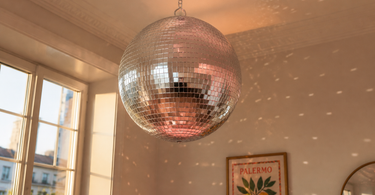
A disco ball is a spherical object covered with small mirror tiles that reflect light in all directions, creating a distinctive play of light. It emerged in the 1920s, became iconic on the dance floors of the 70s and 80s, and is popular today as a decorative element in the home. You can hang it from the ceiling, place it on a shelf, or use it without a dedicated light source – daylight alone activates the reflections.
Disco balls turn up everywhere – in shop windows, over the dinner table and in children's rooms. But what actually is a disco ball, and why has this object retained its appeal for more than 50 years? The answer lies in the physics of reflection and the sense of celebration and movement that the ball's hundreds of mirror tiles can create with a single beam of light. This article covers construction, history, modern use and the practical choices you need to make when integrating a disco ball into your space.
What is a disco ball?
A disco ball – also called a mirror ball or mirrorball – is a spherical object whose surface is covered with a large number of small, flat mirror tiles. The tiles are typically square and measure anywhere from 5 × 5 mm to 20 × 20 mm depending on the ball's size and production category. A standard ball with a diameter of 20 cm can have over 1,000 individual tiles.
The construction in detail
The core is most often made from expanded polystyrene (EPS), cardboard laminate or plastic. The mirror tiles are glued onto the core in rows that follow the curve of the ball – a process that requires the tiles to be slightly angled relative to one another in order to cover the surface without overlaps or gaps. The result is not a smoothly curved surface, but a faceted geometry reminiscent of a cut gemstone.
When a light source – whether a dedicated spotlight, a torch or simply daylight – hits the surface of the ball, each individual tile reflects the light at a specific angle. With a rotating ball or a moving light source, hundreds of spots of light spread across walls, ceiling and floor. It is this simple optical mechanism that has made disco balls an enduring symbol of celebration.
You can see the full range of disco balls in various sizes and materials and get an overview of the most common construction types.
The history behind it: From the 1920s to Studio 54
The origin of the disco ball is older than most people imagine. The first documented mirror balls appear in American and European dance palaces in the early 1920s. Here they hung as static decorative elements rather than active lighting instruments, but the idea of multiplying light through reflection was already established.
The 1970s and the disco era
It was in the 1970s, however, that the disco ball's cultural status exploded. The discotheque as a musical format and architectural space emerged in the US and Western Europe, and nightclub architects literally built around the balls. When Studio 54 opened on Manhattan in 1977, mirror balls weren't just decoration – they were an architectural and dramaturgical device that heightened the visual intensity on the dance floor.
The film Saturday Night Fever from 1977 cemented the link between the mirror ball and disco culture worldwide. The song "More, More, More" by Andrea True Connection, DJ culture and colourful light shows with rotating balls merged into a cultural icon that is still directly referenced in pop culture and design today.
The 1980s and the decline
As the disco era faded out in the late 1970s and early 1980s, disco balls disappeared from mainstream nightclubs. "Disco Demolition Night" in Chicago in 1979 – an event where thousands of disco records were blown up on a baseball field – signalled a cultural rejection. But the balls remained hanging in the ceilings of many provincial discos, youth clubs and private basements as nostalgic relics.
The revival: Disco balls in modern interiors
From the mid-2010s, disco balls began to reappear in interior magazines, at design fairs and on social media. There were several driving forces: nostalgic aesthetics, a broader interest in lighting design in the home, and a willingness to introduce playful, unexpected elements into otherwise minimalist spaces.
Today, disco balls are used in private homes in ways that have nothing to do with celebration in the classic sense. A small 10 cm ball on a bookshelf creates subtle points of light when the afternoon sun hits it. A 30 cm ball hung in a window nook works as a sculptural centrepiece. Interior designers use them to break up flat, monochrome surfaces with dynamic, shifting light.
The RICE disco balls are a good example of how manufacturers have adapted the classic design for home use – with sizes and surface finishes suited to the living room or children's room rather than a dance floor with a capacity of 500.
Tip: Hang your disco ball near a window facing south or west. Even on overcast days, enough diffuse light gets through to activate the reflections, and on sunny days the spots of light move slowly across the walls in step with the sun's path.
Sizes, materials and types
Disco balls are produced in a very wide range of sizes. The smallest commercial variant starts at around 5 cm in diameter and is primarily used as table decoration or Christmas decorations. At the other end of the scale, you'll find professional stage versions of 100 cm or more, which require motorised hanging systems and dedicated lighting fixtures.
| Diameter | Typical use | Tile size | Weight (approx.) |
|---|---|---|---|
| 5–10 cm | Table decoration, Christmas tree | 5 × 5 mm | 50–150 g |
| 15–20 cm | Shelf, window, small space | 5–10 × 5–10 mm | 200–600 g |
| 25–40 cm | Living room, bedroom, hanging | 10 × 10 mm | 1–3 kg |
| 50 cm+ | Event, business, large hall | 15–20 × 15–20 mm | 5–20 kg |
Material types
Traditional disco balls use genuine glass mirror tiles laminated onto an EPS core. These are heavy and fragile, but give the sharpest reflection. Newer variants use plastic mirrors (PET film), which are lighter and less vulnerable to knocks – an obvious choice for the kids' room or outdoor use. Some design versions use coloured or coated tiles that create rainbow effects rather than classic white light.
Besides the classic mirror ball, there are also variants with textured surfaces – such as crocheted textile balls from RICE, which have a completely different tactile quality and a softer expression, while still referencing the disco ball's iconic silhouette. See the range of RICE disco balls to compare the different surface treatments.
Placement and hanging in the home
The choice between hanging and standing a disco ball isn't just aesthetic – it directly affects how the light effect works in the room.
Hanging from the ceiling
A hanging ball activates the reflections in a circular motion as the ball's position changes – either because it swings in a draught or because it's mounted on a rotation motor. Hanging is recommended for balls over 20 cm, as the weight is too great to stand stably on most surfaces. Use a ceiling hook with sufficient load capacity: a 30 cm glass mirror ball can weigh up to 2.5 kg.
Mount the hanging fixture in a ceiling joist or use an expansion anchor in concrete – never just in plasterboard. A swivel connection (rotating joint) is a good investment, as it lets the ball's rotation follow air movements in the room without twisting the hanging wire.
Standing placement on a shelf or table
Balls under 20 cm can be placed on a shelf, a table or a windowsill. Here, stability is key: the spherical shape will roll unless you use a ring holder (a circular support that holds the ball in place). You can use anything from a ceramic pot to a custom-made acrylic ring.
A south-facing windowsill is the most effective placement for a standing ball without a light spot. Daylight changes angle throughout the day, creating a passive, continuous play of light without electrical aids.
Find inspiration for placement in our complete guide to disco balls for the home, where size, hanging and stand solutions are gathered in one place.
Use without a light source – does it work?
The classic disco ball setup in a nightclub requires one or more PAR spots (specially aimed light fixtures) mounted at an angle of 45–60° to the ball's surface. But at home, this setup is rarely necessary or practical.
Daylight as a light source
Glass mirror disco balls react to any light source, including diffuse daylight. The intensity of the light effect depends on:
- Light source strength: Direct sun gives sharp, moving spots. Overcast daylight gives a softer, more diffuse result.
- Room dimensions: In a low-ceilinged room, the light is reflected over a shorter distance and appears more concentrated.
- Tile size: Larger tiles (15–20 mm) give clearer, larger light spots. Small tiles (5 mm) give a dense, almost shimmering pattern.
Torches and smartphone lights
A strong LED torch or a smartphone's torch function is enough to activate a disco ball in a dark room. Keep the light source moving to vary the pattern. This is especially popular in the kids' room as a play element and a low-effort sleepover trick.
When does a dedicated light spot make sense?
If you want maximum effect and the classic rotating light-show experience in your home, a small LED spotlight (e.g. 10W) combined with a rotation motor is a relatively cheap investment. Motors for home use typically cost 150–400 DKK and can carry balls up to 40–50 cm.
Would you like to see the RICE versions that work perfectly without a light adaptor, the textile balls are an obvious place to start – they're visually activated in daylight, even without direct reflection, thanks to their textured surface.
Frequently asked questions
What is a disco ball made of?
The core is typically expanded polystyrene, cardboard laminate or plastic. Hundreds of small, flat mirror tiles made from either genuine glass or PET plastic foil are glued on top. Glass versions give the sharpest reflection, while plastic versions are lighter and more robust – a better choice for the children's room or outdoor use.
How big a disco ball should I choose for the living room?
For an average living room of 20–30 m², a ball of 20–30 cm in diameter is a good starting point. Larger rooms with high ceilings can carry a 40 cm ball without it seeming oversized. A small 10–15 cm ball is best suited to a windowsill or shelf as a subtle decorative element.
Can I hang a disco ball outdoors?
It depends on the material. Glass mirror balls are sensitive to moisture and temperature fluctuations and shouldn't be placed outdoors permanently. PET plastic versions can withstand shorter exposure to rain and cold, but no disco ball is built for year-round outdoor use. For the terrace, we recommend balls designed specifically for outdoor use.
When did disco balls become popular?
The first mirror balls appeared in dance halls in the 1920s, but the major cultural breakthrough came in the 1970s with disco music and venues like Studio 54 in New York. The film Saturday Night Fever (1977) cemented the ball's iconic status. Today they're experiencing renewed popularity as a decorative accessory.
Does a disco ball work without a dedicated spotlight?
Yes. Daylight – even diffuse, overcast daylight – is enough to activate the reflections. Place the ball near a window for the best effect. An LED torch in a dark room gives a dramatic effect with clear spots of light. A dedicated light adaptor is only necessary if you want the full, classic disco experience.
What's the difference between a disco ball and a RICE disco ball?
A classic disco ball is coated with mirror tiles and its effect is based on light reflection. RICE disco balls are crocheted textile balls inspired by the disco ball's shape, but with a softer, decorative surface. They're suited to interior use, are light and robust, and can be used in rooms where a glass mirror ball would be too fragile or too dramatic in expression.
Summary
At its core, a disco ball is an optical instrument: hundreds of mirror tiles on a spherical surface that break up and scatter light in all directions. The construction originated in the dance palaces of the 1920s, reached its cultural peak in the discos of the 1970s, and is today reinvented as a versatile decorative accessory. You can hang it from the ceiling, place it on a shelf or put it in a window – and you don't need a dedicated light adaptor to activate the characteristic play of light. Daylight alone is sufficient. Choose the size based on room and placement: 10–15 cm for shelves, 20–30 cm for hanging in the living room, and larger formats for rooms with high ceilings or a more pronounced party effect.
Explore our range of disco balls in all sizes – or see the textile-based RICE disco balls for a softer, decorative expression.