
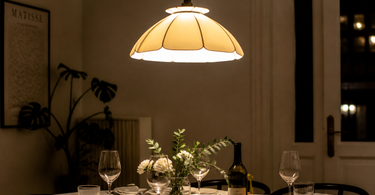
The lamp's diameter should be approximately ½ to ⅔ of the table's width. Hang it 75–85 cm above the tabletop – this gives good lighting without glare. Over a long dining table, 2–3 smaller pendants work best; over a round table, choose one central lamp. These three rules of thumb cover most situations and give a visually balanced result.
The lamp above the dining table is the room's visual anchor point and sets the tone for the whole dining experience. Yet size and placement are things most people choose by gut feeling – and end up with a lamp that's either too small and gets lost in the room, or too big and feels overwhelming. Fortunately, there are concrete measurements to stick to, and they're simple to calculate. This article guides you through them step by step, whether you have a rectangular long table, a round dining table, or something in between.
Diameter: half to two thirds of the table's width
The most important dimension to consider is the lampshade's or pendant's diameter set against the table's width. The rule of thumb states: the lamp's diameter should be approximately ½ to ⅔ of the table's width.
If your dining table is 90 cm wide – a very common standard width – you should look for pendants with a diameter of 45–60 cm. If the table is 100 cm wide, you land in the range of 50–67 cm. The formula holds for most classic round lampshades, but can be adjusted slightly for, for example, elongated or organic shapes.
Why exactly this range?
A lamp narrower than half the table's width will visually "float" and lose its connection to the table. It looks as though it belongs to the room rather than the table. A lamp wider than two thirds of the table's width, on the other hand, risks appearing bulky and heavy – and in practice, people may have to lean around it.
Calculate your measurement quickly
Measure the table's width in centimetres, multiply by 0.5 for the minimum diameter and by 0.67 for the maximum. The result is your search range for the next time you browse lamp collections. Note it on your phone before you shop.
Tip: Cut a circle out of cardboard with the calculated diameter and hold it up above the table at the expected hanging height. This gives a far more precise impression than imagining it from product photos.
Correct hanging height: 75–85 cm above the tabletop
The lamp's lower edge should hang 75–85 cm above the tabletop surface. This is the range where the light spreads optimally across the table's surface, and where you avoid dazzling people sitting down and looking horizontally.
What happens if it hangs too low?
Below 70 cm, the lamp starts to dazzle guests directly in the eyes, and you constantly have to lean to see each other across the table. This ruins the conversation dynamic at the dinner table and generally creates discomfort.
What happens if it hangs too high?
Above 90 cm, the lamp loses its intimacy and connection to the table. The light spreads out into the room instead of concentrating on the table surface, and the special "island of light" effect – which gives dining table lighting its cosy factor – disappears.
Practical adjustment
Measure from the tabletop up, not from the floor or ceiling. Most pendants come with a cord or rod that can be adjusted. Temporarily place a piece of tape on the wall 80 cm above the table as a reference height when mounting. Most people will land close to 80 cm as the ideal compromise within the range.
Lighting over a long table: several pendants or one long lamp
A rectangular long table of, say, 200–240 cm poses a particular challenge. A single pendant with a diameter of 50–60 cm would only light the middle section and leave the ends of the table in relative shadow. There are two good solutions here.
Solution 1: 2–3 pendants in a row
Hang two or three identical pendants at even intervals along the table's length axis. Use the same hanging height (75–85 cm) and keep the distance between the lamps' centres at approximately 60–80 cm. With three pendants over a 220 cm table, you'd place them, for example, at 40, 110 and 180 cm from one short end. The result is an even distribution of light and a clear visual rhythm.
Solution 2: One long pendant or linear light fixture
Elongated pendants and linear pendant systems – typically 80–120 cm long – are designed for exactly this purpose. They cover the table's entire middle zone and create a cohesive look rather than three separate lights. Choose a length that corresponds to approximately ½ of the table's total length.
Whichever solution you choose, you can supplement it with mood lighting on the table. candlesticks at different heights add an extra layer of warm lighting that balances the overhead light from the pendants. The combination of direct table lamps and candles gives the liveliest table setting.
Lighting over a round table: one central solution
Over a round table, the starting point is different. Here, guests sit in a circle, and there are no "ends" to consider. A single, central pendant is the natural solution – and it looks visually correct because the lamp's round shape mirrors the table's round shape.
The diameter rule still applies
Use the same formula: the lamp's diameter = ½ to ⅔ of the table's diameter. A round table of 120 cm gives a search range of 60–80 cm for the lampshade. A table of 90 cm (for example, a small kitchen table for two) correspondingly gives 45–60 cm.
Placement directly above the table
It sounds obvious, but make sure the lamp hangs precisely centred above the table's middle – not above the room's centre, which isn't necessarily the same. Measure from the table edges and mark the centre with tape on the ceiling before you drill.
On a round table, there's often limited space for table decorations, since everyone sits close to the centre. A low centrepiece arrangement with ceramic candlesticks in two to three different sizes works well, because they don't block the view across the table.
Ceiling height and cord length: how to adjust
The standard ceiling height in Danish homes is typically 240–260 cm. With a standard table height of 74–76 cm and a recommended hanging height of 80 cm above the tabletop, the underside of the lamp should hang at approximately 154–156 cm from the floor.
This means that the total cable length from the ceiling rose to the underside of the lamp should be approximately 85–106 cm, depending on your exact ceiling height. Many pendants come with 1.5–2 m of cable that can be rolled up and secured inside the canopy – check this before buying.
High ceilings – special considerations
In rooms with a ceiling height over 280–300 cm (e.g. older flats or new open-plan houses), you can afford to raise the lamp slightly – up to 90 cm above the tabletop – without losing the lighting effect. The visual weight of the lamp can also benefit from being increased in these rooms, as large volumes of air tend to "swallow" light and small lamps.
Low ceilings – special considerations
With a ceiling height of 220–230 cm, the cable length becomes very short. Here, flat shades or pendants with a short rod are better than deep, bowl-shaped shades, as the latter can end up hanging at an unacceptable height. Always calculate your margin before ordering.
Combine the table lamp with table decorations
The table lamp handles the overall lighting, but a well-set dining table is about layers. Candles, vases and smaller sculptural elements add texture and warmth that complement the pendant light.
Placement of table decorations
Keep table decorations at a height that doesn't compete with the underside of the lamp. Generally, the tallest elements on the table (e.g. tall candlesticks) shouldn't exceed the underside of the lamp minus approximately 20 cm. This preserves the sense of space and stops the table looking cluttered.
Glass candlesticks are an obvious choice for the dining table, because the transparency of the glass doesn't block the view across the table, even when they're relatively tall. The light from the candle is refracted in the glass, creating a warm, moving counterpoint to the still overhead light from the pendant.
If you want a coordinated table setting, you can combine different materials: for example, a ceramic candlestick for the matt, tactile expression and a glass candlestick for the transparent, light feel – placed at different heights along the table's central axis.
| Table type | Recommended lamp configuration | Diameter/size | Height above tabletop |
|---|---|---|---|
| Round table (90–120 cm) | 1 central pendant | 45–80 cm (½–⅔ of the table's diameter) | 75–85 cm |
| Rectangular table (up to 160 cm) | 1 pendant or 1 linear pendant | ½–⅔ of the table's width | 75–85 cm |
| Long table (180–240 cm) | 2–3 pendants in a row, or 1 long linear pendant | Each pendant: 35–50 cm; linear: 80–120 cm | 75–85 cm |
| Low ceiling (<230 cm) | Flat shade or short rod | As normal, but prioritise a low profile height | 75–80 cm |
| High ceiling (>280 cm) | Deep shade or larger fitting | Preferably at the higher end of the range | 80–90 cm |
Frequently asked questions
Can I use a lamp that's wider than ⅔ of the table's width?
It's possible, but rarely a good idea. A very wide shade will visually dominate the table and can, in practice, be a nuisance for those sitting at the short ends. Staying within the ½–⅔ range gives you balance without compromising on comfort.
What if my ceiling rose isn't positioned above the centre of the table?
Here you can use an adjustable ceiling mount (also called an "offset canopy" or "canopy with extension"), which lets you shift the lamp's suspension point by up to 20–30 cm relative to the position of the ceiling rose. Alternatively, an electrician can move the ceiling rose – this is often a manageable job.
Does the height rule still apply if I use a lampshade with a very open bottom?
Yes, 75–85 cm still applies, but with a very open shade (e.g. a wire pendant with no proper shade) you can allow yourself to hang it a little lower – down to 70 cm – because there's no direct glaring element at eye level. Always test with someone seated before locking the fitting in place.
Should all the pendants above a long table have the same diameter?
They don't have to, but it's clearly the easiest choice for a harmonious look. If you choose varying sizes, there should be a clear intention behind it – for example, a gradual scaling from the middle out towards the ends. Random size differences rarely look good.
What's the right bulb strength for the dining table?
Above a dining table, you typically want 200–400 lumens per square metre of table surface for general cosy lighting, and up to 500 lumens/m² if you use the table for tasks like reading or playing board games. Choose bulbs with a colour temperature of 2700–3000 K for a warm, inviting light.
Can I use dimming on the dining table lamp?
A dimmer is a clear advantage at the dining table. You can turn it up during cooking or games and down during the meal itself. Remember to check that both the bulbs and the dimmer are compatible – LED bulbs require specifically LED-compatible dimmers to avoid flickering.
Summary
Finding the right lamp size above the dining table comes down to three concrete measurements: a diameter of ½ to ⅔ of the table's width, a hanging height of 75–85 cm above the tabletop, and a number of lamps suited to the table's length. Above a round table, a single central pendant is the natural solution; above a long table of 180 cm or more, 2–3 pendants or a single linear pendant give the best light distribution. Always complement the table lamp with candles in candlesticks to create that layer of warmth that only a living flame can give. With these measurements as your starting point, you'll make a well-considered decision – whatever the shape of your table and the proportions of your room.
Explore our range of candlesticks for the dining table and find the combination that suits your table and your lighting.