
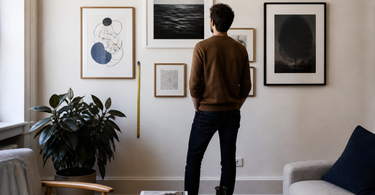
The middle of a picture should hang 145–155 cm from the floor – corresponding to average eye height. Above a sofa, position the bottom edge 15–25 cm above the back of the sofa. Above a chest of drawers or sideboard, keep 10–15 cm between the top of the furniture and the picture frame. On a gallery wall, use one shared centre line to create visual calm. These three rules cover 90% of all hanging situations.
Hanging pictures and wall décor is one of the most underrated disciplines in interior design. Too high, and the picture "floats" detached from the room's furniture and proportions. Too low, and it feels oppressed. The good news: there are precise, well-tested rules of thumb that work whether you're hanging a single poster print or building an entire gallery wall. This guide takes you through them all step by step – with concrete measurements you can take straight to the wall.
The eye-height rule: 145–155 cm from the floor
The classic museum rule is the best starting point for the vast majority of situations: the picture's centre is placed 145–155 cm from the floor. Museums and galleries around the world use 152–157 cm as standard, because it corresponds to the eye height of an average adult, requiring the least possible neck movement to view a picture comfortably.
How to calculate the precise hanging height
You need three measurements:
- The picture's total height – e.g. 60 cm
- The distance from the top of the picture to the hanging fixture – e.g. 8 cm (measure with the wire/sawtooth hanger in taut condition)
- Your desired centre height – use 150 cm as standard
The formula: Nail/hook height = Centre height + (Half the picture's height) − Hanging distance
With the example figures: 150 + 30 − 8 = 172 cm from the floor is where the nail should sit.
The rule works particularly well in hallways, corridors and walls used for freestanding wall décor with no furniture in front. Here, eye height is the only reference point you have.
Tip: Use painter's tape to mark the picture's outline on the wall before hammering in the first nail. Move the tape around until the proportions feel right – it takes 2 minutes and saves you unnecessary holes.
Pictures above the sofa
The sofa is the piece of furniture that most hanging relates to, and here a different logic applies than the pure eye-height rule. When you're sitting down, your eye height is typically 100–115 cm from the floor – and the picture should still feel visually anchored to the piece of furniture, not floating freely up near the ceiling.
The 15–25 cm rule
The bottom edge of the frame is placed 15–25 cm above the top edge of the sofa back. Less than 15 cm, and the picture risks being knocked by heads and cushions. More than 25 cm, and the visual connection to the sofa is broken.
In practice: if you have a sofa with a back 90 cm high, the picture's bottom edge should hang at 105–115 cm. For an 80 cm high picture, that means the centre sits at 145–155 cm – so the two rules actually harmonise nicely with each other in most cases.
Width proportions
The width of the picture or picture group should make up 2/3 to 3/4 of the sofa's width. A 240 cm wide sofa calls for hanging in a width of 160–180 cm. Feel free to use a single, wide picture, a triptych, or a composition of posters arranged as a horizontal group.
Pictures above furniture and chests of drawers
Chests of drawers, sideboards, shelf tops and consoles act as a kind of visual base for wall art. The piece of furniture and the picture should read as one unified whole – not two separate elements on the wall.
The 10–15 cm rule
Keep 10–15 cm between the top surface of the furniture and the bottom edge of the picture. This is close enough for the two elements to "speak to each other", while still leaving room for decoration on the furniture surface – such as a vase, candlesticks or a ceramic object – without it disappearing behind the frame.
Above a low chest of drawers (e.g. 80 cm high) with a 70 cm picture, the centre point will fall at 80 + 12 + 35 = 127 cm. That's lower than standard eye level, but correct in context, because the furniture anchors the picture.
Combining with shelf décor
If you place ceramics for wall mounting or other three-dimensional objects on or around the furniture, you need to factor them into the overall composition. Sketch out a "floor-to-ceiling" layout on paper first, and measure each individual element before you start drilling.
Gallery walls and groupings
A gallery wall with 4–10 pictures in varying sizes needs one guiding principle: a shared, horizontal centre line. Without it, the group will look chaotic, no matter how well thought-out the individual content is.
How to establish the centre line
- Decide on the centre line – use the standard height of 150 cm as your starting point.
- Lay all the pictures out on the floor and arrange the composition there first.
- Measure the width and height of the whole group.
- Find the top and bottom picture in the group. Calculate the deviation from the centre line for each one.
- Transfer the measurements to the wall using a pencil and spirit level.
Spacing
Keep an even distance between the frames: 5–8 cm is standard. Very large frames (60+ cm) can go up to 10 cm. Even spacing creates calm, while varying spacing creates unrest – unless the variation is deliberate and consistent.
Use wall tapestries as an anchor element in the middle of a gallery composition, for example. A textile element breaks up the rectangular monotony and adds depth and texture without disrupting the shared centre line.
Wall type, fixings and hanging
The correct measurements are useless if the fixing doesn't hold. The wall type determines which solution you should use.
| Wall type | Solution | Max. load (typical) | Note |
|---|---|---|---|
| Brick wall / concrete | Rawl plug + screw | 30–80 kg per fixing | Requires a hammer drill |
| Plasterboard wall (with stud) | Screw directly into stud | 20–40 kg | Find the stud with a stud finder |
| Plasterboard wall (without stud) | Wing bolt / plasterboard anchor | 5–15 kg | Not for heavy frames |
| All wall types (light pictures) | Self-adhesive strips (e.g. Command) | 1–7 kg | Perfect for lightweight posters |
| Brick / masonry (exposed) | Masonry anchor bolt | 40–100 kg | Requires a special drill bit for brick |
Cord vs. French cleat
Picture frames with a horizontal cord can "dangle" and are harder to adjust precisely. Consider French cleats (Z-bars or D-rings with two hanging points) for anything over 2 kg. Two hanging points give you a level result without any effort.
The most common mistakes
Even with the right measurements in hand, there are a few classic pitfalls:
1. Too high – always
The most common mistake. People instinctively hang pictures too high because it feels "safe" and airy. The result is that the picture loses its connection to the room's furniture and scale. Stick to a 145–155 cm centre – even when it feels low the first time.
2. Ignoring furniture anchoring
A picture above a sofa that follows the eye-level rule to the letter can still hang too high if the sofa is low. The furniture's position is always the primary reference point, eye level is secondary.
3. Too many pieces in too little space
A gallery wall needs breathing room. A rule of thumb: the entire picture group shouldn't take up more than 60–70% of the available wall space. The rest is air, and the air is part of the design.
4. Mixing too many frame styles
Variation in picture size is visually interesting. Variation in frame material, width and colour all at once creates chaos. Choose one parameter to vary and keep the rest consistent. If you want to mix materials, wall décor in different formats can tie the composition together through colour or motif rather than frame.
Frequently asked questions
How high should you hang pictures above a bed?
The bottom edge of the picture should hang 15–25 cm above the headboard – the same principle as above a sofa. The centre typically ends up at 120–140 cm from the floor, depending on the height of the bed. Be careful not to hang heavy art directly above where you lie down to sleep; use lightweight material or sturdy fixings.
Does the 145–155 cm rule also apply to large paintings?
Yes – the rule refers to the centre of the picture, not the top. A painting 120 cm in height will therefore have its top at 205–215 cm, which is typically fine on walls with a standard ceiling height of 240–250 cm. If the ceiling is closer to 220 cm, you can adjust the centre down to 140 cm.
How do I hang pictures on a sloped ceiling wall?
Follow the angle of the wall and place the picture's centre 150 cm measured perpendicular from the floor (not along the wall). Keep the picture level with a spirit level. On very sloped walls – under 60° – shelf solutions work better than traditional hanging, as the picture will tip forward.
Can self-adhesive strips be used for heavy pictures?
Commercial strips (e.g. Command Large) typically hold up to 7 kg per pair, but only on smooth, clean surfaces. For frames over 3–4 kg, mechanical solutions are recommended. Be especially careful on raw plaster and porous surfaces, where adhesive strength drops significantly.
Should all pictures in a gallery wall have the same centre height?
The centre line should be shared – i.e. the horizontal axis around which the composition is structured. This doesn't mean that every single picture's centre is identical, but that the group as a whole is balanced around one line. Pictures can extend up and down from the shared axis, as long as it's symmetrical.
What is the right height for wall tapestries?
A wall tapestryis typically hung as a single picture: the rod or top edge is placed so that the centre of the tapestry sits at 145–155 cm. If the tapestry hangs above a sofa or bed, the same 15–25 cm rule from the top of the furniture applies as for frames. The tapestry's vertical drape is factored into the calculation of the overall visual centreline.
Summary
Three rules cover almost every hanging situation: centre at 145–155 cm from the floor as standard, bottom edge 15–25 cm above the back of a sofa or bed, and 10–15 cm above chests of drawers and side tables. On gallery walls, the shared centreline is the guiding principle that creates visual calm in a complex composition. Choose your hanging method based on wall type and the picture's weight, and always use two hanging points for frames over 2 kg. With these starting points, the picture sits right the first time – no unnecessary trial holes.
Explore our range of wall décor, posters and ceramics for wall mounting – and find the next piece to go up on your wall.