
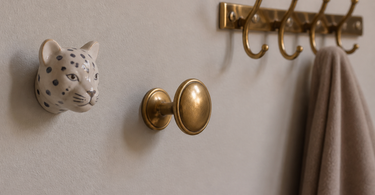
A knage is a wall-mounted hook designed for clothes, bags and outerwear – typically with one or more arms sticking out from the wall. A knop is a small, round protrusion primarily used on cupboard doors and drawers. A knagerække brings several knager together on one rail. All three types come in wood, metal and ceramic, and the choice depends on placement, load and aesthetics.
At first glance, knager, knopper and knagerækker might seem to solve the same task – namely, giving you somewhere to hang or hold something. But the three types are built for very different purposes, loads and placements. Knowing the difference means you avoid buying something that gives way after the first winter coat – or sits so small and unnoticeable on a cupboard door that it's impossible to get a grip on. Below you'll find a precise rundown of definitions, materials and mounting practice.
What is a knage – and what is it used for?
A knage is a single, wall-mounted hook or arm that sticks out horizontally or slightly upwards from the wall and is sized to carry clothes, bags, bike helmets and similar items with a certain amount of weight. The classic knage has a single arm, but you'll also find models with a double arm – an upper arm for clothes and a shorter lower arm for bags or umbrellas.
Typical placements
- Hallway and entrance: The most common placement, where the knage is used for outerwear and bags right by the door.
- Bathroom: Here you need rust- and moisture-resistant materials, typically brass, stainless steel or ceramic.
- Bedroom: Knager behind the door or along one wall are used for dressing gowns, towels and nightwear.
- Office: A single knage for a jacket and bag at the workplace.
In everyday language, the term "knage" often covers both the single hook and the entire knagerække, but as products, they're two separate categories. You can explore the full range under knager and knopper, where both types are gathered.
Load capacity
A standard knage in solid wood or cast metal typically handles 5–15 kg per arm, depending on mounting method and wall material. Double-armed models in steel can often carry up to 20 kg. Manufacturers almost always state a maximum load – check it before hanging up a heavy rucksack or ski set.
Tip: Mount the knage with wall plugs in plasterboard or directly into a stud in the wall behind. A knage screwed into plasterboard without a wall plug with an expansion sleeve rarely handles more than 3–4 kg – far below a full school bag.
Knage, knop and knagerække: what's the difference?
The knage
As described above: a single, projecting arm mounted directly on the wall. Designed for vertical hanging of items. The arm length is typically 8–15 cm, and the end is rounded or shaped like a ball to stop clothes from sliding off.
The knop
A knop is a small, compact protrusion – typically round, cylindrical or shaped like a half-sphere – that primarily acts as a grip on cupboard doors, drawers and cabinets. The knop only projects 2–4 cm from the surface and isn't designed to carry clothes or heavy items. It's mono-functional: you pull it to open or close. See the whole range of knopper for cupboard doors and drawers to get an overview of the many formats and finishes.
Knopper come in a wide range of sizes – from miniature knopper with a 15 mm diameter to large, easy-to-grip models of 50 mm+. They're almost always mounted with a single screw right through from the back of the door, which makes replacement easy.
The knagerække
A knagerække is a horizontal rail or bar from which two to eight (or more) knager are mounted at a fixed distance from each other. The rail is mounted as one complete unit, meaning fewer holes in the wall and more consistent placement than individually mounted single knager. The knagerække is the right solution for busy hallways, children's rooms and wardrobes, where you need system and capacity rather than flexibility.
Comparison table: knage, knop and knagerække
| Feature | Single knage | Knob | Coat rack |
|---|---|---|---|
| Primary function | Hang clothes/bags | Grip on cupboard door/drawer | Hanging clothes/bags (multiple) |
| Typical protruding depth | 8–15 cm | 2–4 cm | 8–15 cm per arm |
| Load capacity | 5–20 kg | Not designed for weight | 5–15 kg per arm |
| Mounting holes | 2 (typical) | 1 (through-hole) | 4–8 (the rail) |
| Typical placement | Wall, hallway, bathroom | Cabinet door, drawer front | Wall, hallway, wardrobe |
| Flexibility in placement | High | High | Low (fixed width) |
| Price per hook/handle | Medium–high | Low–medium | Low (per hook) |
Materials: wood, metal and ceramic
The material doesn't just affect the look – it determines durability, maintenance and which rooms the hook is suited for.
Wood
Wooden hooks come in everything from untreated birch and oak to lacquered beech and oiled walnut. Wood has a warm feel and works well in living rooms, bedrooms and children's rooms. Solid wood carries more weight than chipboard or veneer, and the surface treatment determines resistance to moisture. In bathrooms, you should choose a treated or naturally moisture-resistant wood type such as teak.
Metal – including brass
Metal hooks are generally the most durable and load-tolerant. Brass is a popular choice because it doesn't rust and develops a natural patina over time. You'll find a wide selection of brass hooks and knobs in both polished and brushed finishes. Stainless steel is particularly well suited to bathrooms, while raw iron and black powder-coated steel are popular in industrial-style interiors.
Brass knobs and hooks handle cleaning products well, but avoid abrasive products on polished surfaces – it scratches the finish.
Ceramic
Ceramic is mainly used for single hooks and knobs, less often for hook rails. The material is brittle and not designed for heavy loads, but ceramic hooks offer a handcrafted, unique aesthetic – particularly popular in cosy and rustically decorated homes. Ceramic hooks typically come with a metal base and screw that ensure secure mounting even though the ceramic is porous.
Tip: Mix materials thoughtfully. A brass hook and brass knobs on the neighbouring cabinet create visual cohesion – but never use the same material in so many variations that the room feels themed rather than considered.
Mounting and load
Preparation
Whether you're mounting a single hook or a hook rail, start by identifying the wall material: solid masonry (brick/concrete), plasterboard on studs, or plasterboard without studs. Use a stud finder or a simple magnet test to locate studs in a plasterboard wall.
Mounting in solid masonry
Drill with a masonry bit of the correct diameter for your wall plug (typically 6 or 8 mm). The wall plug's length should be at least 40 mm to provide sufficient anchoring. Tighten the screws firmly, but avoid over-tightening in soft masonry – this widens the hole and reduces holding power.
Fixing to plasterboard
In plasterboard without a stud behind it, you'll need special fixings – such as spring toggles or plasterboard anchors – that spread the load behind the board. These typically handle 15–25 kg per fixing. If you're unsure of the wall type, it's always safer to drill directly into a stud and use a standard wall plug.
Coat racks: extra marking-up
A coat rack requires perfectly horizontal mounting. Use a spirit level – not a guess – and mark all mounting points before you drill the first hole. A coat rack mounted 2° off will become more noticeable with every day that passes.
Knobs: fitting from behind
Knobs for doors are almost always fitted with a single through-screw. Measure precisely from the door's edge and top, and use a drill bit stop to avoid drilling through the door front. Standard screw length is 25–35 mm for doors up to 20 mm thick – always check that the supplied screw fits your specific door type.
How to choose the right type
Choosing between a single hook, a knob and a coat rack comes down, in practice, to three factors: function, room and capacity.
Ask yourself
- Does it need to hold clothes? → A hook or coat rack. A knob isn't built for that.
- Is it for a door or a drawer? → A knob. A hook on a door is a mismatch of function and construction.
- Do you have many users (family, colleagues)? → A coat rack gives more capacity per running metre of wall.
- Do you want the flexibility to move things around? → Single hooks can be adjusted individually; a coat rack is a fixed solution.
- What finish do the rest of the fittings in the room have? → Match the finish – polished brass to polished brass, matt black to matt black.
Once you've worked through the questions above, it's much easier to navigate the range. You'll find all types gathered under knager and knopper, where you can filter by material, finish and mounting type.
Frequently asked questions
What's the difference between a hook and a peg?
In everyday speech, the words are used almost interchangeably. Technically, "peg" often refers to a simple, open bent metal shape (e.g. an S-hook), while "hook" is usually a finished product with a base and mounting plate designed for permanent fixing to a wall. A hook is thus typically more finished and stably mounted than a loose peg.
Can you use a hook as a knob on a cupboard door?
It's technically possible, but not advisable. A hook is designed to bear a vertically hanging load from an arm, while a knob is optimised for the horizontal pull you use when opening doors. A hook on a door will often stick out too far and have an arm that gets in the way.
How high should a hook hang?
For adults, a mounting height of 160–170 cm from the floor to the underside of the arm is recommended. At child height, hooks are typically placed 90–120 cm from the floor. If you're hanging a coat rack, it can be a good idea to fit two rows – one for adults and one for children in a family's hallway.
How much does a standard winter coat weigh?
A heavy winter coat typically weighs 1.5–2.5 kg. A packed school bag can reach 4–6 kg. A hook rated for 5 kg per arm is therefore sufficient for most everyday use – but always allow a safety margin and choose a hook with a load rating that's 50–100% higher than the expected use.
How do you clean brass hooks?
Wipe with a slightly damp cloth and mild soap. Avoid abrasive cleaning agents and scouring pads, as these will scratch polished brass. On untreated brass that develops a natural patina, you can use a brass polish a few times a year if you want to keep the shiny surface – or let the patina develop naturally.
Are ceramic hooks durable enough for a hallway?
Yes, if they're correctly fitted and not overloaded. Ceramic hooks typically handle 3–6 kg per arm. They're not suitable for heavy winter coats or shoe bags, but work well for light bags, keys and scarves. Be aware that ceramic can crack under heavy impact – avoid placing them in corners with a lot of traffic.
Summary
A hook is a wall-mounted arm for clothes and bags with a load capacity of 5–20 kg. A knob is a small handle for doors and drawers – not designed to bear weight. A coat rack combines the capacity of several hooks on one rail and is the most efficient solution when you need space for many items. The material – wood, brass, steel or ceramic – determines durability and maintenance requirements. Mounting depends on the wall material: always use suitable fixings and a spirit level. Knowing these three distinctions means you can make a precise choice without ending up with the wrong product in the wrong room.
Explore our range of knager and knopper – or go straight to brass hooks and knobs for a classic and durable finish.