
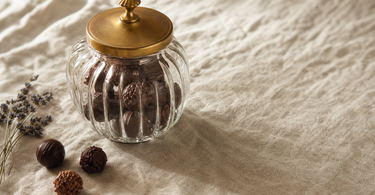
A bonbonnière is a small container with a lid, designed to store chocolates, sweets or biscuits. The word comes from the French "bonbon" (sweet) and became popular in the 1800s as a luxurious table piece. Today, bonbonnières are found in hand-painted ceramics, glass and brass — both as functional sweet containers and as decorative objects on the shelf. At Dims Studio, you'll find both classic glass bonbonnières from AU Maison and brass versions like Lucky Clover Circus.
You've probably spotted one on a shelf — a small lidded container shaped like a miniature urn, a sphere, or a flower wreath. That's a bonbonnière. It looks decorative, but it has a very specific purpose: storing chocolate confectionery and sweets in a way that's both practical and pretty. Here's the full story and guide.
What is a bonbonnière?
A bonbonnière is a small container with a fitted lid, originally designed to store chocolate confectionery or small sweets. It differs from an ordinary jar by being distinctly decorative — designed to be on show, not just to store things. The material is typically ceramic, glass or brass, and the height is usually between 8 and 15 cm.
The story behind the bonbonnière
The word "bonbon" is French and means "good-good" — an affectionate term for sugary sweets. The bonbonnière became part of the French bourgeois home and spread to Denmark in the mid-1800s. It was originally a status symbol: a family with a beautiful bonbonnière displayed in the parlour signalled both wealth and taste.
In the 1900s, the bonbonnière changed character — from an exclusive bourgeois piece of furniture to an everyday object, particularly common on the breakfast table and as a host gift. Today, the bonbonnière has regained its status as a decorative design piece thanks to modern ceramicists and glassmakers.
Did you know? In 18th- and 19th-century France, it was common to serve bonbons from bonbonnières at the end of dinner — a kind of "amuse-bouche" signalling that the feast had reached its conclusion. The tradition lives on in the finest Danish restaurants.
Materials and types
At Dims Studio, you'll find bonbonnières in three main materials:
- Glass: Classic and transparent — you can see the contents from outside. Glass bonbonnières from AU Maison are often mouth-blown with subtle colour variations.
- Brass: More sculptural, often with a finely patinated surface. The Lucky Clover Circus jar is a modern classic.
- Ceramic: Hand-painted with characterful motifs — lemons, flowers, animal patterns.
Use and styling
- Classic use: chocolate confectionery, pralines, filled sweets, pastilles
- For everyday: nuts, dried fruit, liquorice
- As storage: jewellery, coins, small keepsakes, keys
- As decoration: standing empty on the shelf — the shape alone has visual value
- For gifting: a filled bonbonnière is a classic host gift
How to choose a bonbonnière
- Size: 8-12 cm if you mainly use it decoratively. 12-18 cm if it needs to hold a real quantity of sweets.
- Lid fit: A good lid sits tightly enough to keep moisture out, but can be lifted without resistance. Check the fit before you buy.
- Material match: Choose the material to suit the rest of your décor — brass for the classic look, ceramic for the colourful look, glass for the transparent look.
- Care needs: Glass is dishwasher-safe, brass requires hand-washing, ceramic depends on the glaze.
Frequently asked questions
What's the difference between a bonbonnière and a sweet jar?
A bonbonnière is typically smaller, more decorative and has a fitted lid — it's designed to work both as a container AND as an ornamental piece. A sweet jar is often bigger and purely functional. The bonbonnière has its own place in table settings or on the shelf.
What do you typically store in a bonbonnière?
Classically: chocolate confectionery, small pralines and filled sweets. Many also use it for pastilles, liquorice, almonds or even jewellery and small keepsakes. As it's sealed and decorative, it's versatile.
Where does the bonbonnière come from?
The word comes from the French "bonbon" (sweet) and arrived in Denmark via French bourgeoisie in the 1800s. It was originally a status symbol — bourgeois families showed off their wealth through their bonbonnière collection in the parlour.
Are bonbonnières dishwasher safe?
Glass bonbonnières from makers like AU Maison are typically dishwasher safe. Brass versions should be hand-washed to preserve their patina and finish. Always check the care instructions for the individual product.
How big is a typical bonbonnière?
Most are 8-15 cm tall with a diameter of 8-12 cm. Mini versions go down to 6 cm — great as a small decorative piece or for a single portion of sweets. Larger party bonbonnières can be up to 25 cm.
Summary
The bonbonnière is neither a necessary nor a traditional everyday kitchen item — but that's exactly what makes it valuable. It tells a story, it works as a little piece of art on the shelf, and it holds the sweets without hiding them away. A well-chosen bonbonnière stays in the home for decades.
Explore our range of bonbonnières and jars — from mouth-blown glass to handmade brass.