
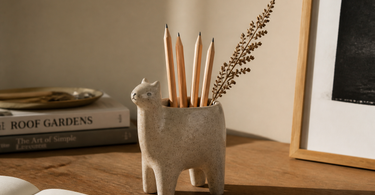
A pencil holder is a small, open container-object designed to keep writing implements upright and gathered together on a desk. Historically, it emerged as a practical office item, but nowadays it's used just as often for brushes, scissors, flowers and other small bits and bobs. It comes in materials such as ceramic, glass, metal and wood — and effectively functions as a multifunctional miniature vase.
The word "pencil holder" sounds functional and dull — a tool for parking a pencil. But if you look more closely at the object, it's actually a remarkable little thing: an open tube or cylindrical container that, over several hundred years, has travelled from monasteries and trading houses to modern offices, studios and living rooms. The question "what is a pencil holder?" therefore has a more nuanced answer than the immediate definition suggests.
What exactly is a pencil holder?
In its basic form, a pencil holder is an upright, open container with a diameter and depth sufficient to hold one or more writing implements stably in a vertical position. That's the formal definition — but it doesn't say much about the object's actual range of use.
In terms of construction, a pencil holder is characterised by:
- Open top — no lid, so implements can easily be grabbed and put back.
- Sufficient height — typically 8–15 cm, so a standard pencil (19 cm) doesn't topple over.
- Stable base — either a solid bottom or a wide foot, so the object doesn't tip at the slightest touch.
- Suitable diameter — usually 6–10 cm, enough for 5–15 pencils depending on type.
The line between a pencil holder and a small vase is, in practice, wafer-thin. Many of the same objects are used in both roles, and designers explicitly design them with both purposes in mind. It's largely a matter of context and what you put in them.
Tip: If you want to use a pencil holder as a vase for short stems, choose a model with an opening diameter of at least 6 cm and a depth of at least 10 cm. This way, the flower stems sit stably without falling to the side.
A brief history
The history of the pencil holder is closely tied to the development of writing and administration in Europe and Asia. The earliest known examples weren't intended for pencils — as the pencil in its current form (a graphite core in a wooden casing) wasn't invented until the 1560s in England — but for quill pens, reed pens and calligraphy sticks.
China and the Chinese desk set
In Chinese culture, "wendai" (文臺) — desk implements — have held a prominent place since at least the Tang dynasty (618–907 AD). A complete Chinese desk set typically included a brush holder made of bamboo, porcelain or jade. These brush holders are direct ancestors of the modern pencil holder and were often high-quality craftsmanship.
Europe: from chancellery to office
In a European context, dedicated holders for writing implements appeared in monasteries and trading houses in the late Middle Ages. With the Industrial Revolution and the rise of large office environments in the 1800s, the pencil holder became a mass-produced standard product. In the first half of the 1900s, it was a fixture on every secretary's desk.
Today, it has come full circle: it's produced both as a cheap office tool and as a design object for the home office, and it's sold in art galleries as well as office shops.
What do you typically keep in a pencil holder?
The obvious answer is pencils and pens — but a review of real pencil holders on real desks reveals a far broader range of contents.
Classic writing implements
- Pencils (HB, B, H gradients)
- Ballpoint pens and rollerball pens
- Fibre-tip pens and fineliners
- Highlighters
- Erasers and pencil sharpeners
Office and creative equipment
- Scissors (a small pair of office scissors fits precisely in a standard diameter)
- Rulers
- USB-sticks and stylus pens
- Felt-tip pens and marker pens
- Desk calendars and notepads (in larger models)
Studio and hobby
Artists and hobbyists use pen holders for brushes, charcoal, pastels and graphite sticks. A pen holder's open, cylindrical shape is, incidentally, identical to the optimal storage shape for brushes: handle down, bristles up, without the bristles bending against the bottom.
Alternative uses: vase, brush holder and more
Because a pen holder is structurally a small, open, waterproof container, it makes sense in a whole range of contexts beyond the desk.
As a mini vase
A ceramic or glass pen holder can easily be used as a vase for short flower stems: anemones, buttercups, eucalyptus sprigs or a single twig. It creates a discreet, sculptural effect on a side table or kitchen shelf — and is functionally identical to a wall vase or a small table vase. The only difference is the context and your intention.
As a brush holder in the studio
Artists, illustrators and craftspeople use pen holders as the primary storage for working brushes. A cylindrical ceramic container with a diameter of 8 cm and a height of 12 cm is actually superior to many dedicated brush holders, because it's heavy enough not to tip over and wide enough to hold many stems.
As a storage object in the bathroom and kitchen
In the bathroom, pen holders are used for toothbrushes, makeup brushes, eyebrow pencils and nail scissors. In the kitchen, they can hold skewers, long matchboxes or the chef's knives (in larger versions). The open top and stable base make it universally useful.
As a cup alternative
Thick ceramic pen holders without inner glazing are aesthetically identical to cups — and used as a pen holder on the kitchen table or bar counter, they create a playful double meaning in the decor.
Materials and construction
The material largely determines the pen holder's weight, durability, aesthetics and usability — including whether it can be used as a vase.
| Material | Typical weight | Waterproof? | Aesthetics | Special properties |
|---|---|---|---|---|
| Ceramic (stoneware) | 300–600 g | Yes (glazed) | Matte, organic | Heavy and stable; suits flowers |
| Porcelain | 150–350 g | Yes | Fine, light, translucent | Fragile; high aesthetic value |
| Glass | 200–500 g | Yes | Transparent, modern | Shows the contents; good for flowers |
| Metal (brass/steel) | 100–400 g | Yes | Industrial, sleek | Risk of rust with prolonged water contact |
| Wood | 80–200 g | No | Warm, natural | Not suitable as a vase; easy to tip over |
| Concrete/cement | 400–900 g | Partially | Raw, minimalist | Very stable; absorbs moisture easily |
If you want to use your pencil holder as a vase or for brushes with water, glazed ceramic, porcelain and glass are the obvious choices. For purely dry office use, all materials are functionally suitable.
How to choose the right one
Choosing a pencil holder comes down to three parameters: function, placement and aesthetics. Let's go through them systematically.
Function: what should it hold?
Reckon on a standard HB pencil having a diameter of 7 mm. A holder with an 8 cm inner diameter can in theory hold over 100 pencils — but in practice, 8–12 items is the comfortable optimum. If it's mainly for brushes or flowers, prioritise depth (min. 12 cm) over width.
Placement: desk, shelf or windowsill?
On a busy work desk, a compact model with a maximum diameter of 8 cm is ideal — it doesn't take up too much space. On a shelf or windowsill, a taller, slimmer model can work as a sculptural element. Here, the pencil holder's function overlaps directly with a decorative vase.
Aesthetics: matteness, texture and colour
Matte surfaces don't collect fingerprints and suit organic, handmade expressions. Glossy glazes and glass give a more polished, contemporary look. Concrete and raw stoneware suit industrial and minimalist interiors. Colour is a matter of taste, but neutral tones — white, black, grey, beige — are the most flexible over time.
Frequently asked questions
What's the difference between a pencil holder and a vase?
Functionally, there's no necessary difference — both are open, cylindrical containers. A pencil holder is typically shorter and wider than a classic vase and optimised to hold long, rigid objects like pencils. A vase is often taller and designed for flower stems in water. But many objects fulfil both criteria simultaneously.
Can I use a pencil holder as a vase for fresh flowers?
Yes, if the material is waterproof — that is, glazed ceramic, porcelain or glass. Avoid untreated wood, raw concrete or untreated metal. Remember to change the water every 2–3 days and cut the stems at an angle to prolong the flowers' lifespan.
What size pencil holder is best for a home office?
For a standard desk, a model with an inner diameter of 7–9 cm and a height of 10–13 cm is ideal. It comfortably holds 8–12 items, won't tip over from the weight of a pencil or pen, and doesn't take up unnecessary space on a limited desk area.
What should I look for in a ceramic pencil holder?
Check that the base is flat and stable (place it on a flat surface and see if it wobbles). Check that the glaze is even on the inside without holes or cracks that could absorb water. A base with a thickness of at least 4–5 mm ensures the holder won't break from a light knock.
Can a pencil holder be used for makeup brushes?
Yes — a cylindrical container in ceramic or glass with a diameter of 8–10 cm is well suited to makeup brushes with the handles facing down. The brush bristles should point upwards so they don't get deformed. Choose a model with a smooth, easy-to-clean surface, as makeup residue can build up at the bottom.
Are there historical pencil holders with particular cultural status?
Yes. Chinese brush holders in jade, ivory and rare porcelain from the Ming and Qing dynasties (1368–1912) fetch prices at auction from 50,000 to over a million kroner. They're regarded as collector's items and craftsmanship on a par with sculptures — not as office equipment.
Summary
At its core, a pencil holder is an open, upright container designed to hold writing implements stably and accessibly. But it's also an object with centuries of history behind it — from Chinese jade brush holders to mass-produced office equipment and back again to a design object. Today, it's used just as often as a mini vase, brush holder, makeup organiser or decorative sculptural element as for its namesake function. The material — ceramic, glass, metal, wood — determines whether it can hold water and therefore flowers. The choice is about matching function, placement and aesthetics to your specific needs.
Explore our selection of pencil holders — from minimalist stoneware to organic ceramic shapes that work just as well as a table vase as on the desk.