
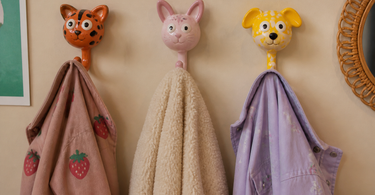
Coat hooks in the hallway hang best at 160–180 cm for adults. In the children's room, they're placed at 100–120 cm, so children can hang up their own clothes. Bathroom towel hooks sit ideally at 140–150 cm, and kitchen hooks for aprons at 145–155 cm. All measurements are from floor to hook head. Always adapt to the actual height of the users and the function of the room.
The question of how high hooks should hang seems simple – but incorrectly placed hooks create daily frustration. If they hang too high, children can't reach them on their own. If they hang too low, long coats drag on the floor. There are actually well-documented rules of thumb for each room in the home, based on average body measurements combined with furniture heights and user behaviour. This article gives you concrete centimetre measurements for the hallway, children's room, bathroom and kitchen – so you get it right the first time.
Why height matters
Hook height isn't just an aesthetic choice – it's about ergonomics and everyday usability. A hook that's positioned incorrectly risks either being overlooked or used incorrectly, for instance by clothes being dumped on the floor because it's too much hassle to hang them up.
The key parameters you need to consider:
- The user's reach: The natural height from which you can hang up a garment without effort is roughly 20–30 cm below your full arm's reach.
- The length of the item: A long winter coat can reach the floor if the hook is positioned too low. Typically, a hook needs at least 90–100 cm of clear height below it for long outerwear.
- The function of the room: A bathroom requires different considerations than a hallway – here, hand height and moisture resistance are key factors.
All measurements in this article are given from finished floor to the middle of the hook head, unless otherwise stated. Remember to subtract 1–2 cm if you're mounting on tiles with grouting, as the hook head ends up slightly higher than the screw itself.
Tip: Stick a piece of masking tape on the wall at the desired height and try hanging your clothes on it – before you drill a single hole. It takes 30 seconds and quickly reveals whether the height is right for you.
Hooks in the hallway – measurements for adults
The hallway is the room that typically places the greatest demands on hook height, because it's here that heavy and long outerwear hangs. The average Dane is 174 cm tall (women 167 cm, men 181 cm), and ergonomic research suggests that the comfortable hanging height is roughly 10–15 cm above shoulder height.
The recommended range: 160–180 cm
For a household with mainly adult users, 165–175 cm is the golden zone. If you choose the lower end (160 cm), it works well in a household with shorter users, and even a 100 cm long winter coat will still have 60 cm of clearance to the floor. If you choose 180 cm, you avoid long jackets and parka coats dragging, but shorter users may find it hard to reach.
Combine two rows
A classic solution in the hallway is two rows of hooks:
- Top row: 170–180 cm – for long coats and adult clothing.
- Bottom row: 100–120 cm – for shorter jackets, bags and children's clothes (see next section).
A double hook rail with two rows is an effective solution in compact hallways where wall space is limited. Explore hooks and knobs for the hallway in different load classes – bear in mind that a single hook should normally be able to hold 10–15 kg, equivalent to a heavy winter coat plus a rucksack.
Spacing between the hooks
Plan for at least 15–20 cm** between each hook, so that hangers don't squeeze against each other. If the hooks are mounted with 15 cm spacing, you can use hangers in your outerwear without it hanging crooked.
Hooks in the children's room – measurements and placement
Hooks at children's height are a simple tool for teaching children independence. When a 5-year-old can hang up their jacket by themselves, it only happens if the hook is actually within the child's reach.
Range: 100–120 cm for children of school age
Children aged 3–5 are typically 95–110 cm tall; 6–9-year-olds are 115–130 cm. A hook placed at 100–110 cm is accessible to most nursery-age children, while 110–120 cm works better for 6-10-year-olds. If you're only fitting one set of hooks, 110 cm is a good compromise that lasts many years.
Hooks for the children's room tend to come in shapes that are sturdier than decorative knobs – they need to withstand a school bag weighing 4–5 kg hanging and swinging on them daily. Check the fitting instructions for recommended screw length; in plasterboard, wall plugs need to be at least 35 mm deep.
Consider adjustable solutions
If you fit a long hook rail with a slot system, you can move the individual hooks up or down as the child grows. Alternatively, you can fit two parallel screw holes 10 cm apart and move the hook up as the child grows into it.
Placement in the room
Hang the hooks by the entrance door to the children's room – not by the bed. This creates a clear, logical order: come in, take off clothes, hook. Feel free to add a small shelf 20 cm above the hook for helmets and similar items, fitted at approximately 130 cm height.
Towel hooks in the bathroom
In the bathroom, the primary function is hanging towels – and here, drying plays a key role. A towel that hangs folded over a single hook dries more slowly than a towel that hangs half on the hook and half free in the air.
Recommended height: 140–150 cm
140–150 cm gives a comfortable hang-and-grab motion for most adults, and the towel hangs without touching the floor. A standard bath towel is 70 x 140 cm. If you fold it in the middle and hang it, it hangs down 70 cm – with a hook height of 145 cm, there's 75 cm to the floor, so a good margin.
If you choose brass hooks for the bathroom, it's important to check whether the finish is sealed and corrosion-protected. Bathroom humidity can attack open brass surfaces over time. Solid brass with clear lacquer or a PVD-treated surface holds up significantly better than thinly plated zinc-brass.
Distance from shower or bathtub
The splash zone rules (DS/EN IEC 60364-7-701) classify the bathroom into zones. Hooks should not be fitted within zone 1 (the direct shower/bathtub area) unless the fitting is IP67-rated. Position the towel hook at least 60 cm from the outer edge of the shower.
Double hooks and bracket hooks
A double hook (two hook bodies on the same plate) allows space for two towels without an extra hole in the wall. Bracket hooks, which project 8–12 cm from the wall, give the towel more air and thus better drying than a simple hook.
Hooks in the kitchen for aprons
Kitchen hooks are an underrated element of a well-functioning kitchen layout. Their primary function is hanging aprons, oven gloves and tea towels – and the usage pattern here differs from the hallway: you grab and hang in one quick motion, often with half-wet hands.
Recommended height: 145–155 cm
145–155 cm places the hook right above the worktop and below the cabinets in most standard kitchens (wall cabinets typically start at 135–140 cm from the floor and end at 200–220 cm). This means a hook at 150 cm can easily sit next to the cabinets or on the free wall beside the fridge.
If there's no free wall space, a hook rail fitted to the side of a tall cabinet is a good alternative – here you can hang 2–3 hooks vertically with 15 cm spacing from 100 to 145 cm, adapted to users of different heights in the household.
See the full range of hooks and knobs – bear in mind that kitchen hooks should be able to withstand grease vapour and regular wiping with cleaning products. Lacquer or powder coating typically holds up better than galvanising in this environment.
Practical tips for mounting
Regardless of room and height, the actual fitting is crucial for the hooks to last over time. Here are the most important practical considerations:
Find the right surface
Use a wall scanner (stud finder) to locate studs behind the plasterboard. A hook fitted directly into a stud (typically 45 x 95 mm timber) holds 5–10 times more than one fitted with wall plugs in plasterboard. For heavy loads (winter coats, heavy school bags), you should always screw into a solid surface or use specialist plasterboard plugs with at least 25 kg pull-out strength.
Horizontal line
Use a spirit level, not your eye. Even a 3–4 mm difference between two neighbouring hooks is visible once clothes are hanging. Stretch a string across the wall at the desired height and use it as a reference for all fitting points.
Check room height and proportions
In rooms with high ceilings (250+ cm), hooks at 175 cm can look low and visually out of place. Here you can fit a decorative shelf at 190–200 cm and hang the hooks below at 170 cm – this gives the wall depth and weight.
| Room | Recommended height | Primary user | Key considerations |
|---|---|---|---|
| Hallway (adults) | 160–180 cm | Adults | Room for long coats |
| Children's room | 100–120 cm | Children aged 3–10 | Independent use, sturdy mounting |
| Bathroom | 140–150 cm | Adults | Drying, moisture resistance, splash zone |
| Kitchen | 145–155 cm | Adults | Quick access, grease-vapour resistant |
Tip: Mounting hooks on tiled walls? Use a diamond drill bit and lower the speed. Drilling too fast into ceramic heats up the tile and can chip the edge. Use a strip of painter's tape as a guide – it stops the drill bit from slipping on the smooth surface.
Considering brass hooks for the hallway or bathroom? Solid brass is heavier than zinc and often needs deeper screws (minimum 40 mm into solid material) to hold the extra weight of the fitting itself plus whatever's hung on it.
Frequently asked questions
How high should you hang hooks in a standard hallway?
The recommended height for adults in the hallway is 160–180 cm from floor to hook head. 165–175 cm suits most households. If you're hanging two rows, place the top one at 170–180 cm and the bottom one at 100–120 cm for children and shorter jackets.
How high should hooks be in a children's room?
For children aged 3–5, 100–110 cm is suitable. For 6–10-year-olds, 110–120 cm works better. If you want one fixed height, 110 cm is a good compromise that's accessible to most school-age children and stays relevant for years.
What height is recommended for towel hooks in the bathroom?
140–150 cm is the recommended range. It gives a naturally ergonomic hang-and-grab motion, and a standard 140 cm towel folded in half hangs with plenty of clearance from the floor. Position the hook outside the splash zone – at least 60 cm from the outer edge of the shower.
Can hooks be mounted in plasterboard without a stud?
Yes, but use special plasterboard plugs (such as Molly bolts or toggle anchors) with a stated pull-out strength of at least 25 kg per point. For heavy loads like school bags and winter coats, mounting into a stud is always preferable. A stud finder costs under DKK 150 and locates studs precisely.
How much space should there be between hooks?
A minimum of 15 cm between hook heads, ideally 20 cm to leave room for hangers with outerwear. If you're mainly hanging bags and backpacks, 12–15 cm is fine. Always mount with a spirit level to make sure all the hooks sit on the same horizontal line.
What's the difference between brass and gold-plated zinc hooks?
Solid brass is heavier and keeps its colour far longer, but costs more. Gold-plated or galvanised zinc is lighter and cheaper, but the coating can wear and flake off – especially in the bathroom. PVD-treated brass is the most durable choice for damp environments like bathrooms and kitchens.
Summary
Hook height is about the room's users and the size of the items – not random taste. In the hallway, mount adult hooks at 160–180 cm and pair them with a lower row at 100–120 cm for children. In the children's room, 100–120 cm is the right range so kids can hang up their own clothes and bags. Bathroom towel hooks work best at 140–150 cm, while kitchen hooks for aprons should sit at 145–155 cm to stay accessible while you work. Always use a spirit level and mount into solid material when the load is heavy. Getting the measurements right the first time saves you from re-drilled holes and crooked hanging clothes.
Explore our range of hooks and knobs for the whole home – and find hooks for the children's room in sturdy designs built to handle everyday use.